
localized date
Current Time


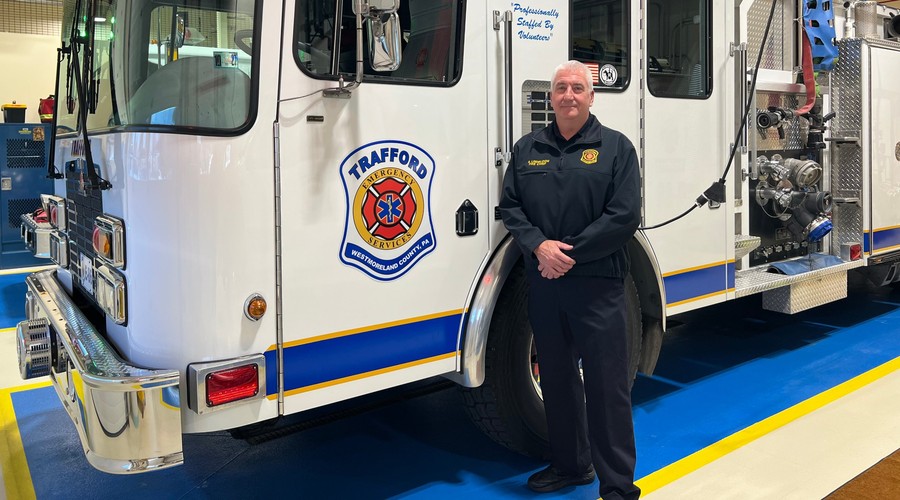
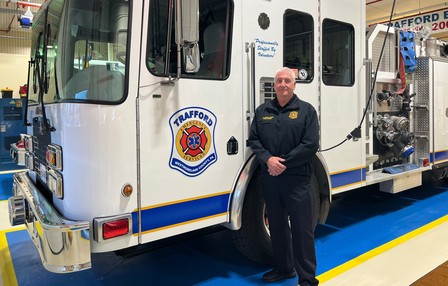
Trafford Fire Chief Brian Lindbloom couldn’t fit $13,000 of fire truck repairs into the department’s $40,000 budget this year. A new truck is even further out of reach.
The department’s newest fire truck and first vehicle on a call is a 27-year-old Ferrara ladder truck, built in 1999. This year, it needed brakes and rotors, replacement tires, and a rebuild of the hydraulic ramp.
In good years, the department could set aside some of what it raised and use that money to cover expenses the following year. Now those reserves are nearly gone.
“For the first time in 27 years, we are paying bills this year with money we raised this year,” said Lindbloom, who has spent 42 years in the fire service. “So that model cannot be sustained. The costs are .... basically, going to put us out of business.”
Trafford Fire Company No. 1 is one of many fire departments across Pennsylvania facing the cost of repairing and replacing aging trucks. In many towns, volunteer fire departments are the only fire protection.
To pay for repairs and equipment replacement, departments can apply for grants or receive funding through a local fire tax or municipal budget. Where local funding is limited, firefighters peddle hoagies, host pancake breakfasts, and hold letter drives in hopes of staying afloat to maybe one day afford a new fire truck.
A used fire truck can cost about $500,000, while a custom-built truck can approach $1 million.
After ordering, departments can wait years for their expected delivery date, said Mark Calderini, third vice president of the Western Pennsylvania Fireman’s Association.
"If you ordered a fire truck today, generally speaking it will be at least three years before you see it," he said.
When a new truck is ordered, it is typically designed and built custom from the frame up.
Brian Borland, a service manager for Fire-Fly Fire Equipment Sales, said that supply chain disruptions from the COVID-19 pandemic caused the price of truck parts to exponentially increase. If a department waits an entire year to buy a truck, the cost can increase by $120,000, he said.
Municipalities are responsible for providing fire services, emergency medical services and law enforcement, Calderini said. How much a fire department needs to raise on its own depends on how much its municipality contributes.
In September, the City of Pittsburgh ordered 13 new fire vehicles after announcing a $20 million partnership with Highmark Health. The city did not disclose the price of each vehicle or where the apparatus would be stationed.
Two months earlier, the city filed an antitrust lawsuit alleging that fire apparatus manufacturers used anticompetitive practices to monopolize the market for fire trucks and parts.
The National Emergency Response Information System lists more than 2,200 fire departments across Pennsylvania’s 67 counties. Of those, about 1,550 are volunteer departments.
Municipal support helped Penn Hills Fire Department Station 227, also known locally as Penn Hills No. 7, replace its last ladder truck. Fire Chief Bill Jeffcoat said the department was in the right place at the right time when it found a 2009 Pierce Arrow XT ladder truck that was a demo model. It’s still the department’s newest truck.
“Our municipality said they could assist us with basically a third of the cost,” he said. “So, we were able to purchase that apparatus for $844,000, that same vehicle today is well over $2 million.”
Station No. 7 has five vehicles in active service. Its oldest is a 1996 Sutton heavy rescue truck, and its first out on calls is a 2007 Pierce Quantum pumper.
Jeffcoat said that since the fire service primarily relies on donations, fundraising puts a strain on both the department and the community.
In February, the department spent $19,000 on ladder truck repairs for fuel injectors and to replace a computer, then in April an additional $24,000 to replace the turbocharger.
The latest expense, Jeffcoat said, was a backed-up floor drain. Initially, a company quoted the repair as a $50,000 fix, but after further investigation, the cost rose to $147,000.
State Rep. Joe McAndrew (D-32nd) helped the department find a $50,000 grant to fund some of the cost, he said, but the rest came out of the department’s savings account.
“The money that we set aside, you know for apparatus replacement or various improvements to apparatus or equipment, whatever that may be, just gets blown out of the water,” he said. “What took us years to save and have a safe cushion, can be wiped away in a small event.”
While used trucks are more affordable, not just any truck can be purchased, Calderini said. Each fire department has specific needs depending on where they are located and how large their garages are.
“You have to buy a fire truck that meets your specs,” he said. “In other words, a very congested city can't use a very large, long fire truck; you can't get around the streets.”
The price of a replacement truck depends on its size, type, and features, Borland said. If the truck is larger and has more features, it drives up the price.
"They place it on volunteer stations to raise the funds themselves in order to afford those apparatus,” Borland said.
While departments try to pay for apparatus, they also must keep up with strict out-of-service requirements for air packs and turnout gear. That equipment is expensive too: outfitting one firefighter costs about $5,000 to $6,000, Borland said.
As replacement costs rise, more fire chiefs are extending the life of their vehicles with repairs, Borland said. Previously, vehicles were replaced every 10 to 15 years. Now, he’s watching departments extend truck replacement to every 20 to 25 years.
“We're seeing an influx on our service garage of trucks being repaired, or they're updating older trucks,” Borland said. “They're taking these trucks and they'll do what's called a refurbishment, which is basically - it's like a frame-off restoration for a car.”
Bill Brucker, chief of the Center Township Volunteer Fire Department, said his department in Beaver County has been fortunate to have the township’s support with major vehicle purchases.
"The last time large equipment was purchased was 2001," Brucker said. "Our township blessed us with the purchase of six large apparatus at one time, and that was three engines, a ladder truck, an air cascade truck, and a heavy rescue."
The cost of six vehicles in 2001 was $1.4 million, he said. Today, that would barely pay for two trucks.
"I mean, you can’t buy a fire truck anymore on rip tickets and fish fries," he said. "It’s a struggle, and these are life safety pieces of equipment that every municipality needs."
Penn Hills No. 7 is on pace to answer 1,300 calls this year, Jeffcoat said. Trafford No. 1 answers 180 to 200 calls a year and handles another 40 to 60 public service requests, Lindbloom said. Those have included installing smoke alarms in seniors’ homes, removing a bat from someone’s house and, for Lindbloom’s second time ever, getting a cat out of a tree.
The only thing the Trafford Council covers for the department is the fire company’s building and utilities. Unless the council contributes more soon, Lindbloom said the department will need to downsize, merge with another department or find another way to serve the borough.
“By code you have to provide fire protection,” he said. “So, they will have to do something. What that's going to be, I don't know.”
The department holds at least one fundraiser a month. A hoagie sale brings in about $800, Lindbloom said.
This year's letter drive raised $16,000. Out of 2,000 letters sent out, the department received about 300 responses, Lindbloom said. He estimated that if every recipient had responded, the drive could have raised $100,000, enough to address the department’s financial problems in one go.
Regardless, Lindbloom said he was thankful for the community's support thus far.
Fundraising also takes a toll on volunteers, Borland said. As the number of volunteers has declined, he said, the time they spend raising money and taking required training can lead to burnout. He added that it's the nature of a volunteer department to wash its trucks more than drive them.
“At this point, it has burned out a lot of volunteers because they're too busy fundraising or they're too busy taking classes to excel their programs in the fire company,” Borland said.
There's no single answer to address the aging fire fleet. Calderini said that departments in individual areas should communicate and do a needs assessment to determine how many large, expensive trucks they need there.
Calderini spent 20 years as a career firefighter at Sarasota County Station No. 1 in Florida before retiring and returning to Pennsylvania. He now volunteers with the West Hills Regional Fire Department, just outside Johnstown in Cambria County.
Calderini also suggested organizing fire services by county, similar to sheriff’s departments. But he said consolidation would eliminate individual fire chiefs, risking "political suicide" for those people in many areas.
“[If] you've consolidated under a county umbrella, you have one fire chief, you have one set of rules,” he said. “You have one budget, you have planning, you have professional people that are doing financial planning. It's a much more effective and efficient way of running.”
Calderini added that keeping fire services running depends as much on having enough volunteers to staff the trucks as it does on making sure the trucks are safe to operate.
"We used to say in Williamsport, I don't care what color your fire truck is and how pretty it is," he said. "I need people. I need people to do the work. Fire trucks don't put fires out. People do."
Cassandra Harris is a reporter for the Pittsburgh Media Partnership Newsroom. A spring 2026 graduate of Point Park University, she interned at Pittsburgh Magazine, Pittsburgh Latino Magazine, and The Homepage Newspaper. Reach her at cassandra.harris@pointpark.edu.
The PMP Newsroom is a regional news service that focuses on government and enterprise reporting in southwestern Pennsylvania. Find out more information on foundation and corporate funders here.