

localized date
Current Time

.png)
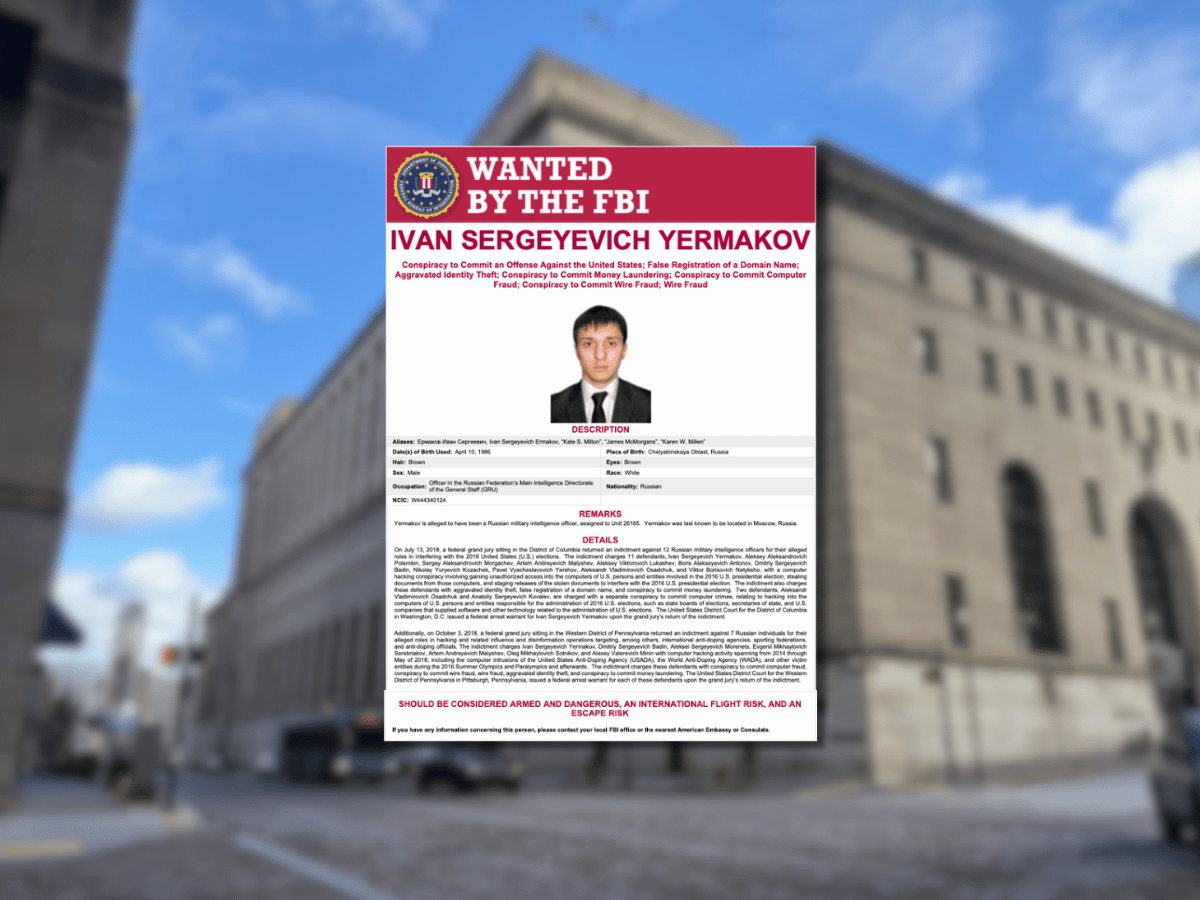
A Russian national accused of high-level computer hacking remains wanted by the FBI nearly eight years following federal indictments in western Pennsylvania and Washington, D.C.
A federal grand jury in Western Pennsylvania returned an indictment in 2018 against Ivan Yermakov and six other alleged members of Russia’s military intelligence agency, the Main Intelligence Directorate of the General Staff, or GRU.
According to the indictment, as early as November 2014, Yermakov and his co-conspirators targeted Westinghouse, referred to as both Westinghouse Electric Corporation and Westinghouse Electric Company in the indictment, a global nuclear technology company based in Cranberry.
Federal arrest warrants were issued by the U.S. District Court for the Western District of Pennsylvania for each defendant. All seven remain at large.
Like other Russian nationals on the FBI’s public Cyber Most Wanted List, Yermakov is likely aware of his active arrest warrants and will avoid traveling to the U.S. or other countries where he could be extradited, according to Bradford Arick, public affairs officer at FBI Pittsburgh.
“If FBI Pittsburgh becomes aware of a fugitive traveling to a cooperating country, we often work with those partner countries to apprehend and extradite those subjects,” he said in a statement.
Beyond Yermakov, the Western District has played a prominent role in public U.S. indictments of foreign state-backed hackers.
In 2014, a local grand jury became the first to file criminal charges against known state actors for hacking, according to the Justice Department, when it charged five Chinese military hackers for cyber espionage.
Since then, the Justice Department has unsealed or initiated similar indictments — totaling approximately two dozen cases from 2014 to 2019, according to Garrett Hinck and Tim Maurer, authors of “Persistent Enforcement: Criminal Charges as a Response to Nation-State Malicious Cyber Activity.”
Yermakov, like many others in his position, may never see the inside of a courtroom in the U.S. Russia and the U.S. do not have an extradition agreement.
“All of these indictments, it is extremely unlikely that we would ultimately apprehend the subject of the indictment,” said Mailyn Fidler, assistant professor at the University of New Hampshire Franklin Pierce School of Law.
But the local indictment was not Yermakov’s first or last.
While Hillary Clinton and Donald Trump battled for the presidency, he participated in the hack of the Democratic National Committee’s email server in May 2016, stealing emails later released to the public, according to a federal grand jury indictment.
Yermakov is one of 12 people indicted for conspiracy to commit an offense against the U.S. in a July 2018 indictment in the District of Columbia, the result of investigations by special counsel Robert Mueller.
The indictment states that Yermakov is a Russian military officer for “Fancy Bear,” the nickname for Unit 26165 of GRU, an agency known for its brazen and disruptive operations, according to the Atlantic Council.
Legal action of foreign nationals like Yermakov, who are not in U.S. custody, can be controversial. Pejoratively, the practice is referred to as “naming and shaming” — a phrase that implies limited consequences for the defendants in a case.
But publicly indicting foreign nationals for hacking has become more routine, said Garrett Hinck, Ph.D. candidate at Columbia University.
“I think in the U.S. context it has, in some sense, become a part of the expected set of policy tools, if you will, that are used in response to these operations,” Hinck said.
Yermakov was indicted a third time in 2021 when a Massachusetts grand jury accused him of participating in a hack-to-trade scheme.
He, along with others, obtained insider information on companies that enabled “tens of millions of dollars” in illegal profits on securities trades, according to the indictment.
For Russian hackers, the line between official state business and criminal activity can be murky. The Atlantic Council has described an ecosystem in which Russian authorities tolerate or encourage cybercriminal activity against foreign targets and, in some cases, recruit cybercriminals for state operations.
Although Yermakov remains at large, Stephen Frank, a litigation partner at international law firm Quinn Emanuel, said criminal charges are important. Frank led the prosecution of Yermakov and others in Massachusetts.
“It sends a message to would-be criminals that if they engage in this activity, they are going to be living a confined life,” he said.
“What we know from the investigation of Yermakov is that he very much wanted to leave Russia,” Frank said. Yermakov discussed traveling under an assumed name and with a fake passport. “At some point, staying in Russia your whole life, particularly when you have great wealth made from illegal actives, becomes confining.”
Following the indictment, one of Yermakov’s alleged co-conspirators, Vladislav Klyushin, was arrested in Switzerland on a skiing trip, Frank said, and extradited to the U.S. A federal jury in Boston convicted him for involvement in the hack-to-trade scheme. The U.S. later released him to Russia in a prisoner exchange.
“When an individual travels to a third country, that's when we tend to have the most success with extradition,” Fidler said.
The United Kingdom and New Zealand sanctioned Yermakov in 2025 and 2026, respectively. Both are members of the “Five Eyes” an intelligence alliance of English-speaking countries.
As of 2026, Fancy Bear is still active, according to an FBI announcement in April. Since at least 2024, Fancy Bear has collected credentials and exploited routers to steal military, government, and critical infrastructure information.
Hannah Frances Johansson is a reporter for the Pittsburgh Media Partnership newsroom. She holds a master's degree from the UC Berkeley Graduate School of Journalism. Reach her at hannah.johansson@pointpark.edu.
The PMP Newsroom is a regional news service that focuses on government and enterprise reporting in southwestern Pennsylvania. Find out more information on foundation and corporate funders here.
Header image: An FBI most wanted poster with Ivan Yermakov, who was indicated in federal court. Pictured in background: The federal courthouse in Downtown Pittsburgh.




.png)

.png)