

localized date
Current Time

.png)
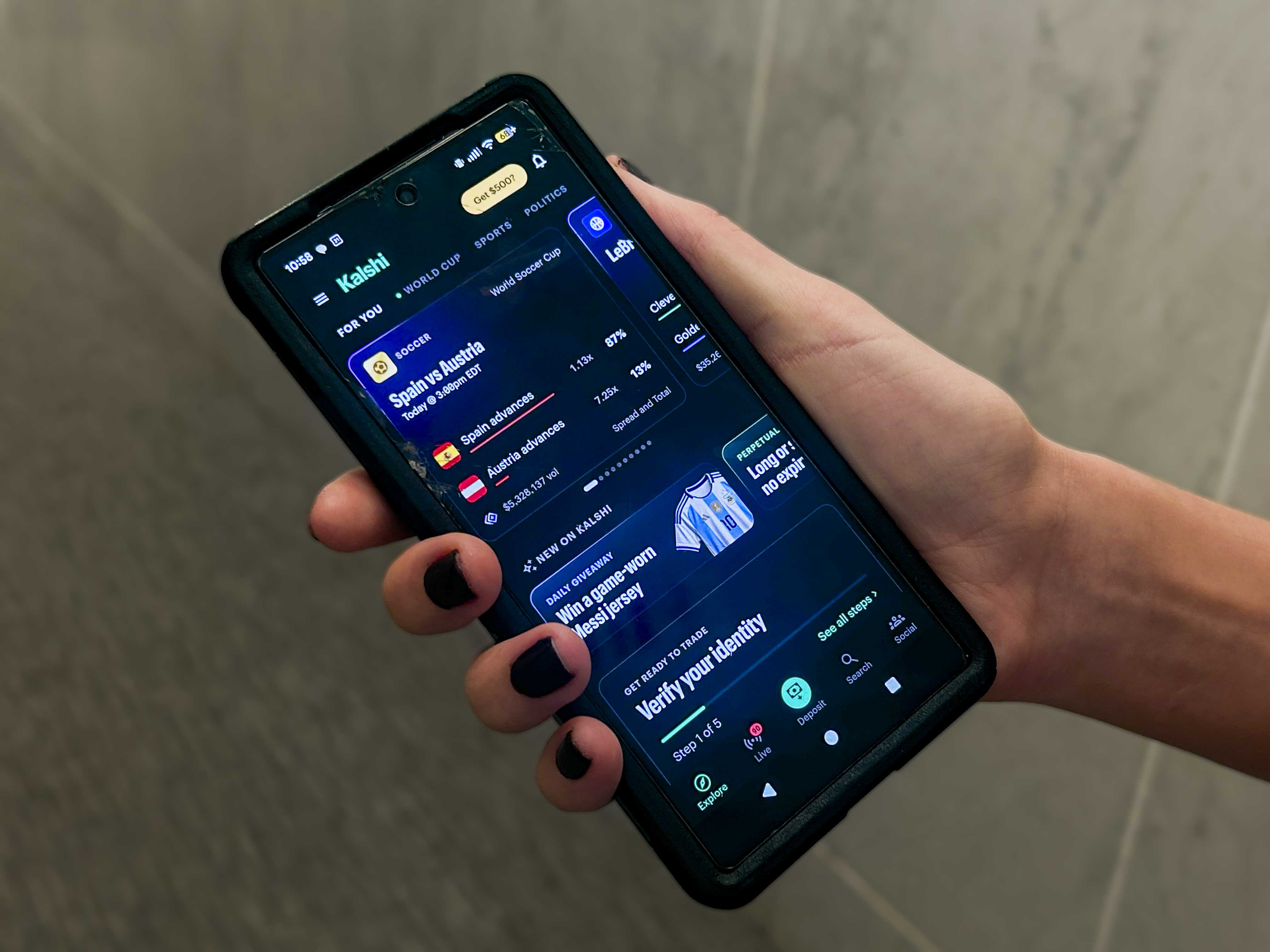
Online prediction markets are making it easier than ever to put money on the outcomes of real-world events — from elections and sports to entertainment and global conflicts.
And business is booming in Pennsylvania.
But unlike Pennsylvania casinos and sportsbooks, prediction-market exchanges are not licensed or supervised by the Pennsylvania Gaming Control Board. That means they aren’t subject to the same state requirements concerning problem-gambling information, including self-exclusion and a minimum participation age of 21.
That distinction matters in Pennsylvania, where state-regulated gaming generated nearly $6.8 billion in revenue in 2025 and approximately $2.98 billion in taxes and fees for the Commonwealth, according to the PGCB.
The platforms offer contracts tied to outcomes in politics, sports, international affairs, and entertainment. Although prediction markets are regulated federally as financial exchanges, addiction experts say some users experience similar harms without access to some state gaming safeguards.
KalshiEX and Polymarket US operate federally designated contract markets where customers trade event contracts tied to future outcomes. The exchanges are overseen by the Commodity Futures Trading Commission rather than state gaming regulators.
Whether some of those contracts may also be regulated under state gambling laws is the subject of ongoing litigation and rulemaking.
Because prediction-market platforms are not licensed by the state Gaming Control Board, they are not subject to the specific Pennsylvania requirements that licensed online gambling operators are, such as displaying helpline information, maintaining approved problem-gambling plans and honoring the state’s gaming self-exclusion lists.
Eligible adults 18 or older may trade on Kalshi and Polymarket US — two prominent prediction platforms in the U.S. — subject to identity verification and other eligibility restrictions.
Topics range from who will win the FIFA World Cup to when Israel will launch a major ground offensive in Gaza, how many tweets Elon Musk will post each week, or if John Fetterman will leave the Democratic Party.
Kalshi and Polymarket did not respond to emailed requests for comment.
Regardless of how prediction markets are classified under law, users frequently don’t make a practical distinction between them and sportsbooks, said Josh Ercole, executive director of the Council on Compulsive Gambling of Pennsylvania.
“They don’t know that it’s a prediction market versus a sportsbook app. They’re participating in an activity almost the identical way that they were with another one,” Ercole said. “Sometimes that comes out in conversation where people might call and say, ‘I have a sports betting problem,’ and then when we’re talking to them, we come and find out that it’s actually on a prediction market platform that’s really their biggest issue.”
When looking for help with a gambling problem, people can find resources through advertisements in casinos or online gambling platforms in the form of the 1-800-GAMBLER, a national gambling hotline. These hotlines provide callers with various resources, such as counseling or group support meetings. Casinos can offer self-exclusion, a voluntary self-ban from casino property.
Prediction-market exchanges are not subject to Pennsylvania’s specific requirements to display those resources or participate in the state’s self-exclusion programs. Prediction-market advertising has also become more visible as the platforms have gained popularity.
The absence of equivalent state-level protections can make it difficult for people struggling with harmful financial behavior to fully remove themselves from those spaces, said Jody Bechtold, CEO of Better Institute, based in the Pittsburgh area.
“We're also seeing people that have had a history of problematic gambling, even to the extent where they have deleted the apps for gambling, self-excluded with the state, and then they got into prediction markets, and the cycle started all over again,” said Bechtold, a gambling addiction expert.
The CFTC states that prediction market swaps are financial contracts between participants rather than bets against a sportsbook. Because users purchase event contracts on potential outcomes of world events, their predictions also play a part in building the odds of the event occurring.
Kalshi offers tools such as trading breaks, deposit limits, and a third-party platform called SelfExclude.io, which allows users to set a duration of time and self-ban from online prediction markets. Kalshi was the first to partner with the site. SelfExclude.io states other markets will soon be available to self-ban from.
Kalshi also invested $2 million toward the National Council on Problem Gambling, a nonprofit organization that seeks to mitigate gambling-related harm through advocacy and awareness programs. The NCPG recognizes that prediction markets “functionally mirror gambling,” but remains neutral on the legality.
“Our mission is to mitigate gambling related harm, and what we are seeing with prediction markets, is that functionally — it’s an important distinction — functionally, they very much mirror gambling,” said Cait Huble, NCPG director of public affairs. “And so as we are seeing trends arise in the last decade of this retail participation in financial markets, from day trading, futures, cryptocurrency, prediction markets, we are seeing a significant overlap with the indicators of gambling related harm.”
Experts also expressed concern about younger adults’ exposure to prediction markets and other forms of online financial risk. Ercole said broader access to online gambling has coincided with a younger demographic among helpline callers.
“We started to see higher call volumes come in, but with age, we started to see a shift to a much younger demographic,” Ercole said. “I would say that the biggest growth that we’ve seen is in the 18 to 24 range. That’s probably five to six times what it was pre-2017 with all of the expansion.”
Of the 2,952 helpline intake callers recorded in 2025, 360 — or 12% — were ages 18 to 24. Another 749 callers hung up before their age could be recorded or declined to provide it, according to the Helpline Data 2025 annual report.
Many parents of younger users additionally don’t notice their children using prediction markets, experts say.
“The parents continue with the younger generation to over-parent in the physical world and under-parent in the digital world. And so they really don't even know what's happening,” Bechtold said.
Those concerned for their children are advised to stay educated on how online financial markets work and the risks, have open conversations with their children, encourage financial responsibility, and create boundaries such as screen time limits, encouraging other hobbies, and making budgets together.
Pennsylvania continues to generate a high volume of gross gambling revenue and tax revenue because of the ease of accessibility, said Doug Harbach, Gaming Control Board communications director.
“If you are going to make gambling much easier to access, literally in the palm of your hands, you should expect a couple things. One is, from a business standpoint, the amount of revenue being spent on gambling should increase,” he said. “However, you should also expect that you are going to run into more people that are developing a problem controlling their spend.”
A news release from the Gaming Control Board said that Pennsylvania revenue is collected from slot machines, table games, sports wagering, iGaming, video gaming terminals and fantasy contests. Pennsylvania makes the most revenue in iGaming, home to the highest population of the eight states where iGaming is legal with about 13 million people.
“We definitely need to do a lot more prevention education and just awareness campaigns. Everybody’s targeting the youth, but we need to do it at all ages, all the time,” Bechtold said.
Sarah Naccarato is a summer intern for the Pittsburgh Media Partnership and a senior at Chatham University. She is a one of 19 New York Times Corps mentees in the U.S., and a staff member of the Chatham Communiqué. In 2025, Sarah spent one month in Arles, France as a part of the ieiMedia international journalism and photography Arles project.
The PMP Newsroom is a regional news service that focuses on government and enterprise reporting in southwestern Pennsylvania. Find out more information on foundation and corporate funders here.
Header image: The Kalshi app homepage glows over a user's phone display.





.png)