
localized date
Current Time


In Pittsburgh’s South Side Flats, neighbors call Mike Clark “the Lorax.”
The nickname fits. Clark, vice president of the South Side Community Council, has helped plant more than 400 trees in one of the hottest neighborhoods in the city. South Side Flats is known for narrow rowhomes and concrete – to plant a street tree, the city first has to cut a hole through the sidewalk.
“I had to convince a lot of my neighbors that you could put a tree in the sidewalk,” Clark said. “They grew up here, and they had no trees around, and it didn’t make sense to them. And then you start doing it and they’re like, ‘I’ll have one!’”
Across Pittsburgh, trees can make the difference between a block that feels livable on a hot summer afternoon and one that radiates heat in every direction. That difference is not just uncomfortable. It can cause health risks, raise utility bills, and affect quality of life.
A recent Carnegie Mellon University study found that formerly redlined Pittsburgh neighborhoods – including parts of Garfield, the Hill District, North Side, and South Side – are nearly 5 degrees hotter than the rest of the city. Redlined neighborhoods are areas that were historically denied home loans based on race and ethnicity, leading to a lack of investment. The gap between redlined neighborhoods and other communities is tied to tree cover, green space, and the amount of asphalt and dark surfaces that store heat.
The phenomenon is known as the urban heat island effect: cities become hotter than surrounding areas because pavement, parking lots, rooftops and other hard surfaces absorb and hold heat.
Suzy (Zekun) Li, the first author of the study, said the “most impactful” option in the City of Pittsburgh is increasing green space. A 10% increase in green coverage would lead to a 3.6-degree temperature reduction, she said.
Plants create a natural cooling effect, but as in other cities green space isn’t evenly distributed across Pittsburgh.
The Trust for Public Land’s 2026 ParkScore Index found that Pittsburgh residents living in neighborhoods with the highest concentrations of people of color have access to 47% less nearby park space per person than those living in neighborhoods with the highest concentrations of white residents.
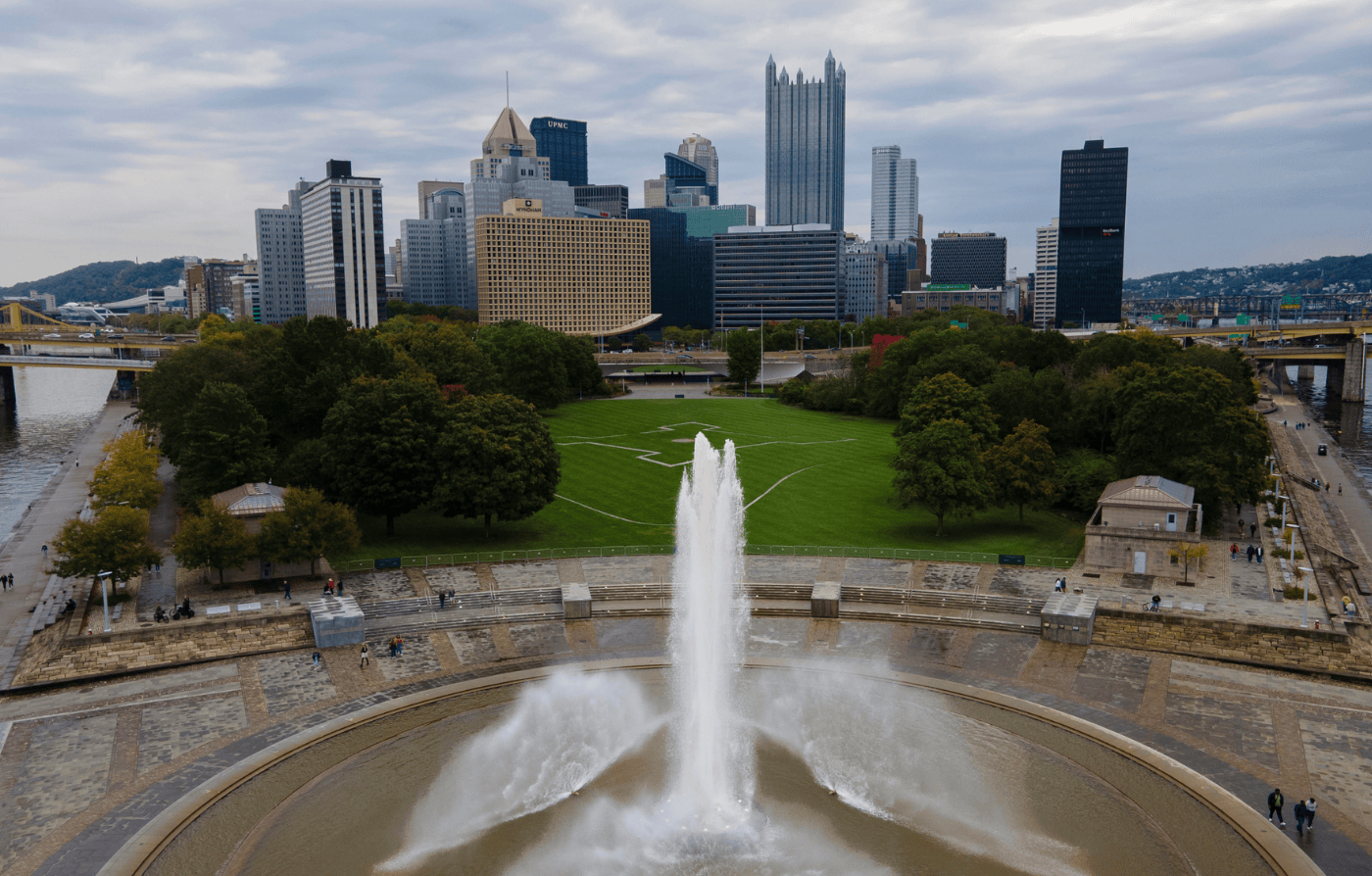
The tree canopy across Pittsburgh is also uneven, ranging from the forest in Hays to streets of Chateau, where tree cover is as low as 5%.
Tree Pittsburgh leaders are trying to get more green in neighborhoods across the region, by planting and maintaining trees.
Their Releaf initiative focuses on areas that have the lowest tree cover, with projects in places such as Homewood, Chateau, and Rankin.
These projects start with community engagement about the benefits of trees, said Clara Kitongo, tree equity manager. Her strategies include using a thermometer to show the difference in heat underneath a shade tree, and tree walks.
“I've walked with folks in community where after walking and observing and seeing the difference, just really being with the trees, then they're able to see them in a different way,” Kitongo said. “I think it’s us reconnecting to our humanity as well.”
Clark credits the TreeVitalize program, a joint program supported by local government agencies and nonprofits such as Tree Pittsburgh, for most of the trees he’s helped plant. TreeVitalize provides the trees and a planting demonstration, and the Community Council brings volunteers to plant 10 to 40 trees in a day.
The program also supplies trees that volunteers plant in South Side Park, four blocks away from bustling Carson Street.
“I looked for South Side Park for a number of years and never could find it,” said Kitty Vagley, the treasurer of Friends of South Side Park. “I finally brought a map one day, and we hadn’t known that what we were looking at was the park. It just looked like derelict property.”

Since the Friends of South Side Park started planting trees and maintaining the green space, she sees many more people in the park. “Plants bring people together,” Vagley said.
The work doesn’t end after a tree is planted. Although trees help cool down hot neighborhoods, the stresses of hot neighborhoods can kill trees. The risk is especially high for trees on the street.
“It’s a harsh environment. You have the heat effects from the street and asphalt radiating up. You have salt issues. You have trucks making deliveries and whacking branches,” said Lisa Coeffe, the city forester. If a street tree lives beyond seven to 10 years, she considers it a success.
Clark says that he’s only lost two trees in the last three years. When he walks around the neighborhood, he pulls dead branches off trees. He’s put down plastic to keep dog urine from killing saplings, and on the hottest days he drives around with a water buffalo in the back of his pickup truck.
Between 2011-15, the city’s tree canopy was in decline. Coeffe said that for the last seven years, the trend has reversed.
Overall, between 2010 and 2020, the City of Pittsburgh had a net gain of 4 acres of tree canopy.
“The canopy ebbs and flows,” Coeffe said. “But we’re trending in the right direction.”
Riona Duncan is a 2026 summer intern for the Pittsburgh Media Partnership newsroom. She is a senior at Carnegie Mellon University where she is studying English and environmental studies. She is also the general manager of WRCT, Carnegie Mellon's radio station, where she has won two Golden Quill awards for audio features. Last summer, she was a newsroom intern at 90.5 WESA.
The PMP Newsroom is a regional news service that focuses on government and enterprise reporting in southwestern Pennsylvania. Find out more information on foundation and corporate funders here.
Header image: Mike Clark works to plant more trees in his South Side Flats neighborhood. Riona Duncan / PMP Newsroom



.png)
.png)