

localized date
Current Time

.png)
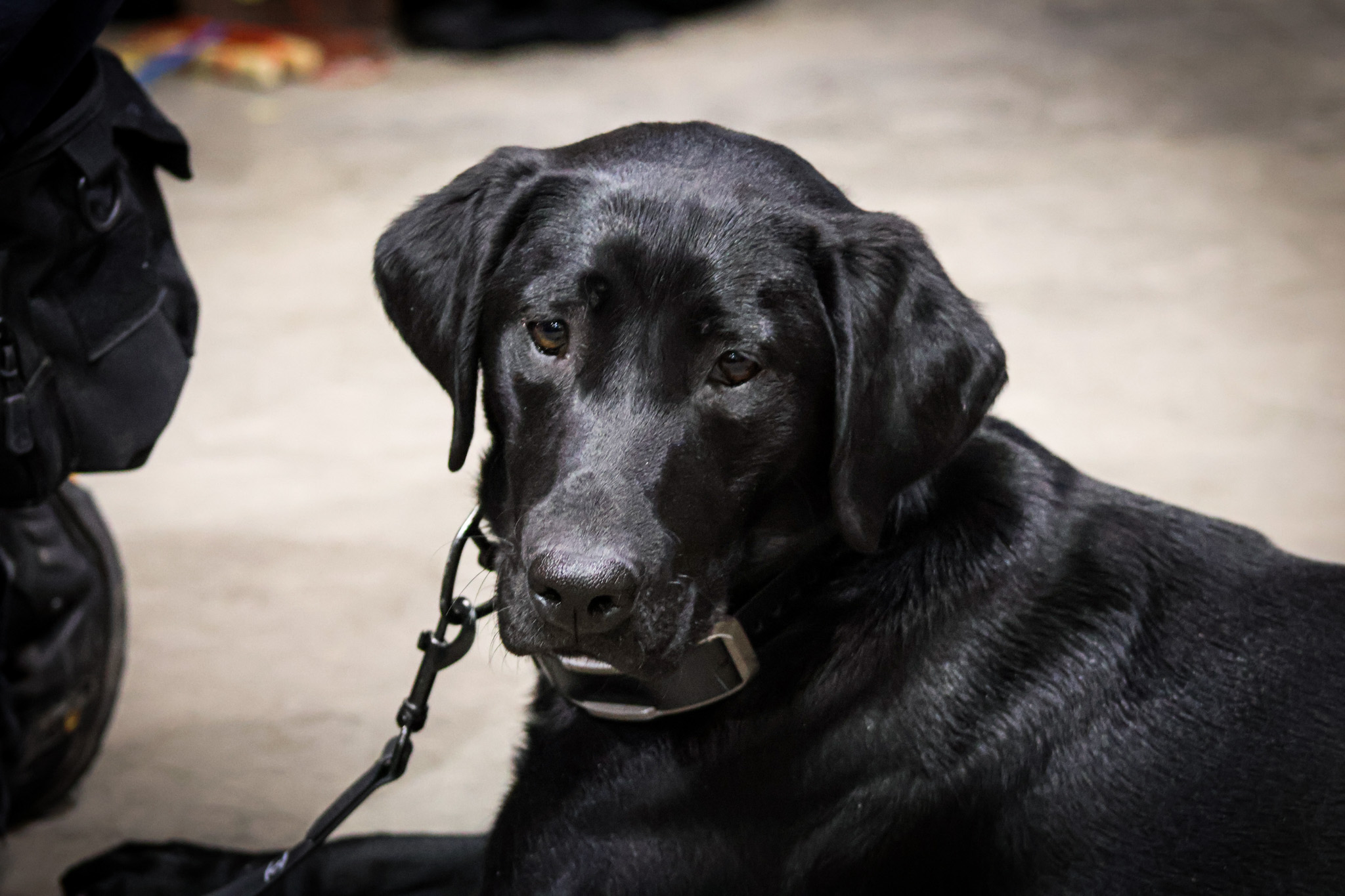
Dogs trained to sniff out people trapped in rubble are coming to Southwestern Pennsylvania for the first time as part of a local urban search and rescue team.
The state Urban Search and Rescue Strike Task Force (PA-ST1) is in the process of becoming a Type 3 task force through the City of Pittsburgh after securing a $6 million state grant last year. The group assists emergency management agencies in structural collapse rescues.
A key difference between PA-ST1’s status and the Type 3 designation is the asset of live find dogs, which are trained to locate people who are still alive. Currently, the dogs are primarily housed in Harrisburg, said Pittsburgh Assistant Fire Chief and PA-ST1 Task Force Leader Brian Kokkila.
“The dogs are the biggest assets in this [higher accreditation] process,” Kokkila said. “Each minute can be a matter of life and death in these structural collapse situations.”
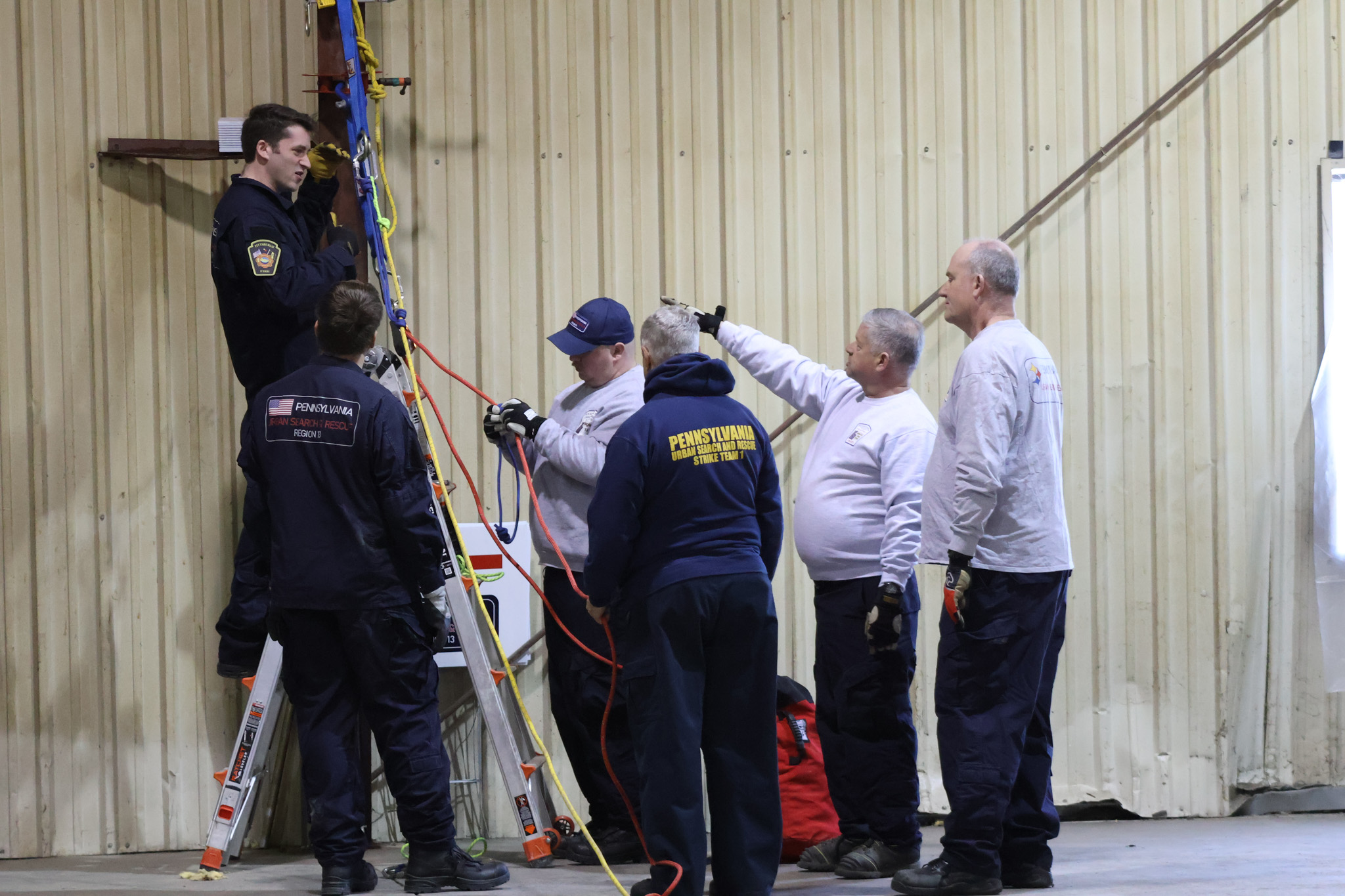
This past Valentine’s Day, members of PA-ST1 met at their warehouse in Carnegie for a bimonthly training session, where they were introduced to the dogs being trained in live find search.
One of the dogs joining the team is Prada, a three-month-old black Labrador retriever from a litter bred in Maine. Her handler, Bill Cummings, has been interested in becoming a canine specialist for over five years. He has attended training sessions with other urban search and rescue task force members in places such as Philadelphia and Maryland.
“Our area has a lot of wilderness dogs or large area search dogs, not a lot of disaster search dogs. There are slight differences in how they search,” Cummings said. “[Prada] will have to find the victim and then alert, so she’ll bark for 30 seconds. We’re still working on that.”
Most of Prada’s training so far has taken place in rubble piles throughout Allegheny County, though PA-ST1 often travels out of state for more specified trainings.
“We have traditionally sent rescue specialists, when the opportunity exists, to the Harrisburg area Community College, but most of them in the last seven or eight years have gone to Virginia Beach for their rescue school,” Kokkila said. “We have some of the [trainings] local, but where we really benefited the State Urban Search and Rescue Alliance, which doesn’t really hold a lot of events [in Southwestern Pennsylvania].”
Another dog joining the team is three-year-old German shepherd Bailey. Her handler, Greg Wehner Jr., became interested in emergency management in childhood and later became a firefighter, joining PA-ST1 in 2024.
“I have two dogs, have done some sports and other trainings with them, and when we found out [PA-ST1] was getting [live find] dogs, I knew I wanted to be a part of that,” said Wehner Jr.
Bailey has lived with Wehner Jr. since she was a puppy, and he knew she would be a good fit for the job.
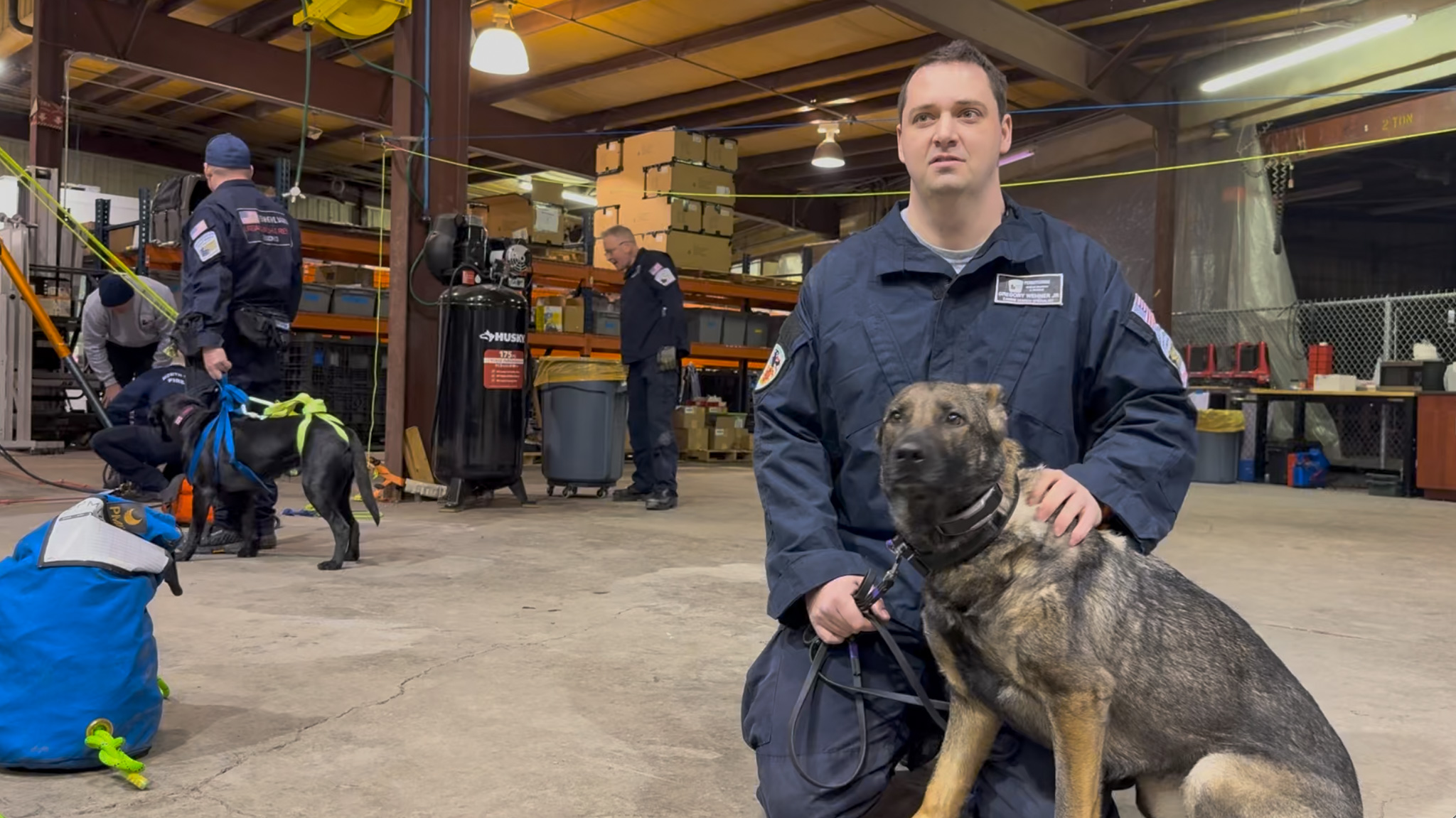
“Right now, we’re focusing on a lot of like obedience level stuff and agility. And then basically working up to the fundamental test to make sure [Bailey] can do the [live find] job,” said Wehner Jr.
The team has also purchased another dog from the same breeder in Maine and is awaiting its arrival.
PA-ST1, sponsored by the city’s Department of Public Safety, responds to emergencies in Allegheny, Armstrong, Beaver, Butler, Cambria, Fayette, Green, Indiana, Lawrence, Mercer, Somerset, Venango, Washington, and Westmoreland counties. They have responded to about 20 incidents since its inception.
The Pennsylvania Emergency Management Agency (PEMA) oversees PA-ST1, which formed in response to the terror attacks of Sept. 11, 2001. The team has since responded to incidents including the fatal explosion at Clairton Coke Works in August 2025 and the 2022 bridge collapse in Squirrel Hill.
The Pennsylvania urban search and rescue system is composed of eight regional task forces and includes one Federal Emergency Management Agency team based in Philadelphia.
PA-ST1 has been working to execute the grant agreement with PEMA since May 2025. The task force has not yet received any of the $6 million passed in the state budget of 2024.
“Significant progress has been made to move it towards execution [of the grant agreement]. One challenge was the PEMA Grant Allowable/Nonallowable guidance,” which Kokkila said the city received at the end of January.
PEMA Director Randy Padfield said the agency sent the grant agreement to the city on May 16, 2025.
“PEMA is awaiting the signed grant agreement from the City of Pittsburgh, including their budget, so PEMA can disburse funding,” Padfield said in a prepared statement. “PEMA looks forward to working with the General Assembly and other stakeholders...to better support the in-state Urban Search and Rescue system across the Commonwealth.”
PA-ST1 has until May 5, 2027, to obtain the higher accreditation, 18 months after PEMA entered into the letter of agreement with the city of Pittsburgh.
According to the state’s fiscal code, the grant funds must be used for equipment, storage, and training to enable the team to meet or exceed FEMA Type 3 Urban Search and Rescue standards. The funding is also designated for a task force within a regional counterterrorism task force covering a “county of the second class,” which is Allegheny County for PA-ST1's coverage area.
Padfield also referenced a report produced in July of last year by the Joint State Government Commission that assessed PA-ST1's capabilities and outlines the steps that need to be taken to officially upgrade the team to a Type 3 task force; this includes acquiring necessary supplies like pharmaceuticals and additional specialized training.
State Sen. Devlin Robinson (R., Allegheny) supported funding for the higher- accredited task force and said he has been closely following the disbursement of state funds.
“We’re hopeful that this will get solved, and the money will go where it was originally allocated by law,” Robinson said. “Time is of the essence, so we have to bring that [new] equipment and all the necessary tools to those disaster areas to make sure that we give the victims of these disasters the best chance of survival.”
PA-ST1 currently has about 100 active personnel who respond when needed, including 60 rescue specialists and nine technical search specialists. Kokkila said he hopes to grow the force to 150 with the new accreditation.
Erin Yudt is a reporter with the Pittsburgh Media Partnership Newsroom, part of the Center for Media Innovation at Point Park University. She most recently was a multimedia content producer and digital reporter at WKBN in Youngstown and is a graduate of Point Park University. Reach her at erin.yudt@pointpark.edu.
The PMP Newsroom is a regional news service that focuses on government and enterprise reporting in southwestern Pennsylvania. Find out more information on foundation and corporate funders here.
Header image: Three-month-old black labrador Bailey lays down at the Pennsylvania Urban Search and Rescue Strike Task Force (PA-ST1) warehouse on February 14, 2026. She is in the process of becoming a live find dog, which specializes in finding people that are alive in structural collapses. Photo by Robert Fornataro.




.png)