
localized date
Current Time

.png)
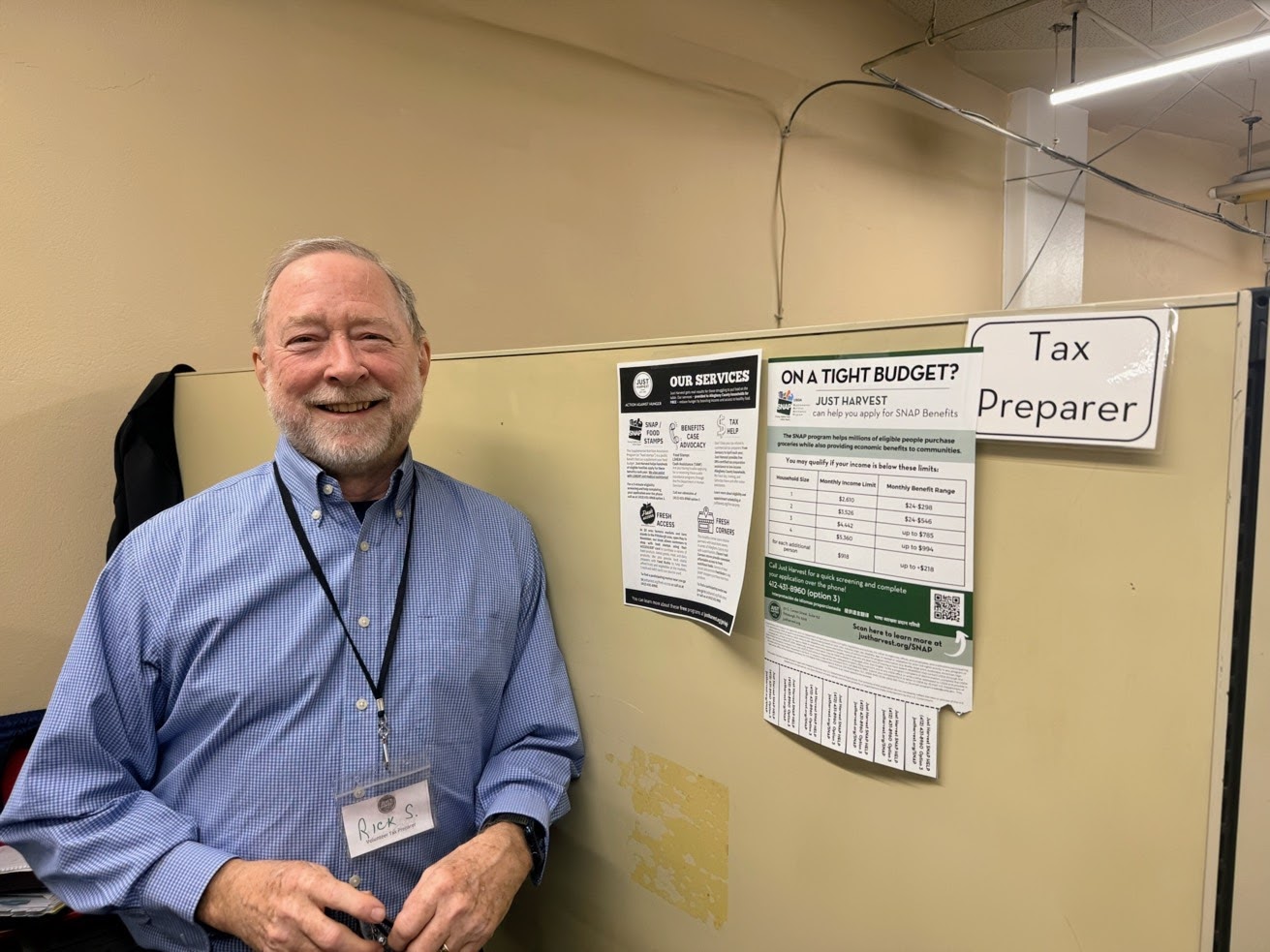
This tax season may not be the most stressful Rick Shaw has seen in his years as a tax preparer, but it is a bit “messy” following last year’s 43-day federal government shutdown.
Shaw volunteers with Just Harvest, a local nonprofit working to address hunger through public policy and food access. One of those efforts is its annual Free Tax Prep Program.
“We're trying to figure out what happened last year. And if we can, give [the public] an idea of what might happen next year if things don't change,” said Shaw, who has volunteered with the organization for 14 years. “You tell them this is going to come in, and you're not going to see it on your return, but it's going to be on the return next year.”
This tax season is shaping up to be especially challenging due to a confluence of factors: new work requirements for SNAP recipients, delayed payments due to the government shutdown, higher utility bills, and a harsher winter season. People may seek free tax prep due to financial challenges, and they also may be confused due to changes in their status.
One of these changes Shaw is referring to is a new tax credit for Pennsylvanians. Close to 1 million will qualify for the Working Pennsylvanians Tax Credit in 2026, signed into law as part of the state budget late last year, was modeled after the federal Earned Income Tax Credit. The maximum state credit is $805.
Just Harvest partners with the United Way of Southwestern Pennsylvania to operate free tax prep sites in Allegheny, Fayette, Greene, Washington, and Westmoreland counties. The services are funded through an IRS grant.
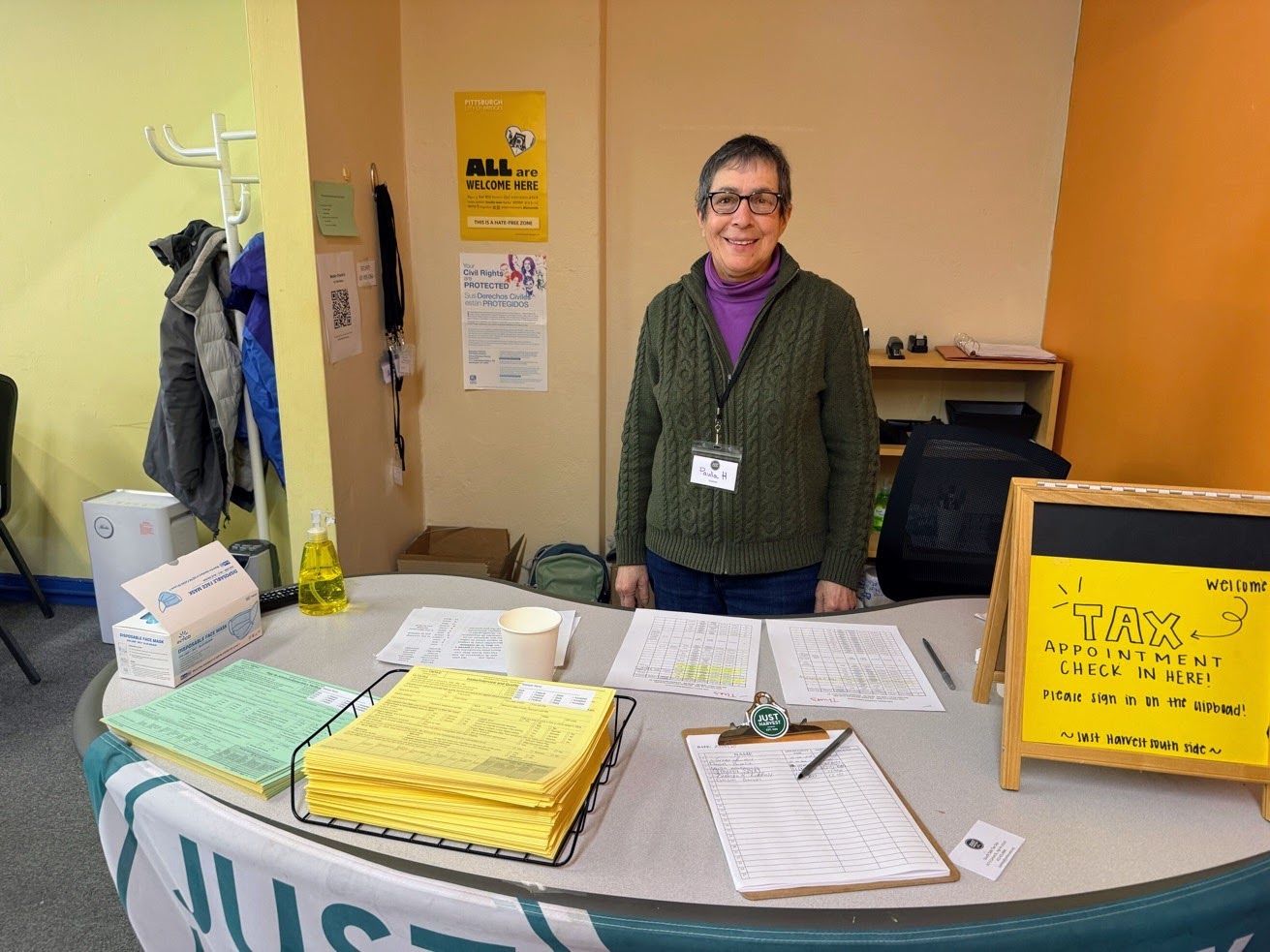
Kristie Weiland Stagno, who runs the Free Tax Prep Coalition, said this year’s tax season —which began Jan. 21 for the group — has brought more volunteers. She said the coalition did about 230 appointments at the South Side preparation site in languages other than English in 2025. The site requests interpretation services at least three times a day.
During a tour of the preparation site this month, state senators Lindsey Williams (D-West View) and Jay Costa (D-Forest Hills) joined state Rep. Emily Kinkead (D-Brighton Heights). Williams’ office helps schedule AARP Tax-Aide appointments at the Shaler Undercliff Fire Company and the Ross Township Municipal Building.
“Our normal call volume [is] 300 or so a week. The first week, we had 750 calls that week — about 500 tax related,” Williams said. “We connect [callers] with a bunch of different services... like food stamps. It’s very hard on our staff for those couple of weeks with the very increased call volume, but it’s a great touch point to get them.”
Williams also pointed to recent changes to work requirements for SNAP benefit users. January was the last month recipients received their typical payment before the new requirements took effect. More than 2 million Pennsylvanians receive SNAP — over half are families with children.
Changes to SNAP work requirements began last fall. Recipients ages 18 to 54 without dependent children were required to report at least 20 hours per week of work, education, training or volunteering if they were physically and mentally able to work.
In November, the requirements expanded to include adults who are 55 to 64, veterans, unhoused individuals, and current or former foster children aged 18 to 24. Those living in a SNAP household with children under 14 are exempt.
Nearly 30,000 people in Southwestern Pennsylvania were projected to lose government food assistance under the expanded rules.
The Greater Pittsburgh Community Food Bank provides food across 11 counties through more than 1,000 partner organizations. During the government shutdown in November, the organization distributed 1 million pounds of food in a single week — its highest weekly total to date. Leaders say demand has been higher this winter than in previous years, in part because of January’s historic winter storm.
A spokesperson said assistance remains steady as residents continue to “recover from the lapse in SNAP benefits” this fall.
The food bank saw a 60% increase in calls related to food assistance in October and served an average of 10 million meals in November and December. From July 2024 to June 2025, the food bank distributed 53 million meals — 5 million more than the previous year. Leaders expect that total to climb even higher in the 2025-26 fiscal year.
According to the PA 211 State Dashboard, SNAP-related requests in Allegheny County rose 90% from Jan. 1 to Feb. 10 compared with the same period last year.
In January alone, 598 food-related needs were reported — up 52% from a year earlier.
Emily Schmidlapp, manager of Moving to Financial Stability at the United Way, oversees the organization’s Free Tax Prep Coalition with Just Harvest. This year, the coalition has more than 470 volunteers across 32 locations.
“There’s always a need for volunteers, and there’s always a need for more funding,” Schmidlapp said. “With more funding, we can open more sites and get one-on-one interaction with the community.”
For the first time this year, the coalition is also offering self-prep assistance at seven Carnegie Library of Pittsburgh locations.
“You don’t need an appointment; the income limit is higher... it’s more for people who want to do their own taxes but might need a final check,” Schmidlapp said.
Just Harvest Grassroots Organizer Dan McCarthy said the Earned Income Tax Credit and their free tax prep service will help put more money in people’s pockets for household expenses.
“When we were able to expand that at the state level, I think it's like a place to start... we connect people to way more things than just tax help,” McCarthy said. “It eases the burden for sure.”
The Free Tax Prep Coalition will be taking appointments through April 15. To schedule, visit Just Harvest’s website or call the United Way’s helpline at 2-1-1. To be eligible, individuals must earn less than $50,000, or less than $70,000 for households with more than one person. If appointments are not available or you cannot attend a self-prep assistance session, the United Way recommends visiting myfreetaxes.com.
Erin Yudt is a reporter with the Pittsburgh Media Partnership Newsroom, part of the Center for Media Innovation at Point Park University. She most recently was a multimedia content producer and digital reporter at WKBN in Youngstown and is a graduate of Point Park University. Reach her at erin.yudt@pointpark.edu.
The PMP Newsroom is a regional news service that focuses on government and enterprise reporting in southwestern Pennsylvania. Find out more information on foundation and corporate funders here.
Header image: Veteran volunteer Tax Preparer Rick Shaw stands near his cubicle on Tuesday, Feb. 10, 2026, where members of the public come to him and other Just Harvest volunteers forfree tax preparation. He said in his 14 years of volunteering, interacting with the public haschanged his life, and he is learning something new constantly. Erin Yudt /PMP Newsroom



.png)



.jpg)