

localized date
Current Time

.png)
“You kind of feel it with your whole brain.”
Fish from Japan and Scotland make their way from sea to sushi, served in Pittsburgh’s Strip District in 72 hours or less.
Henry Dewey, owner of Penn Avenue Fish Company — a fish market and restaurant in the Strip District — procures his seafood from all over the world.
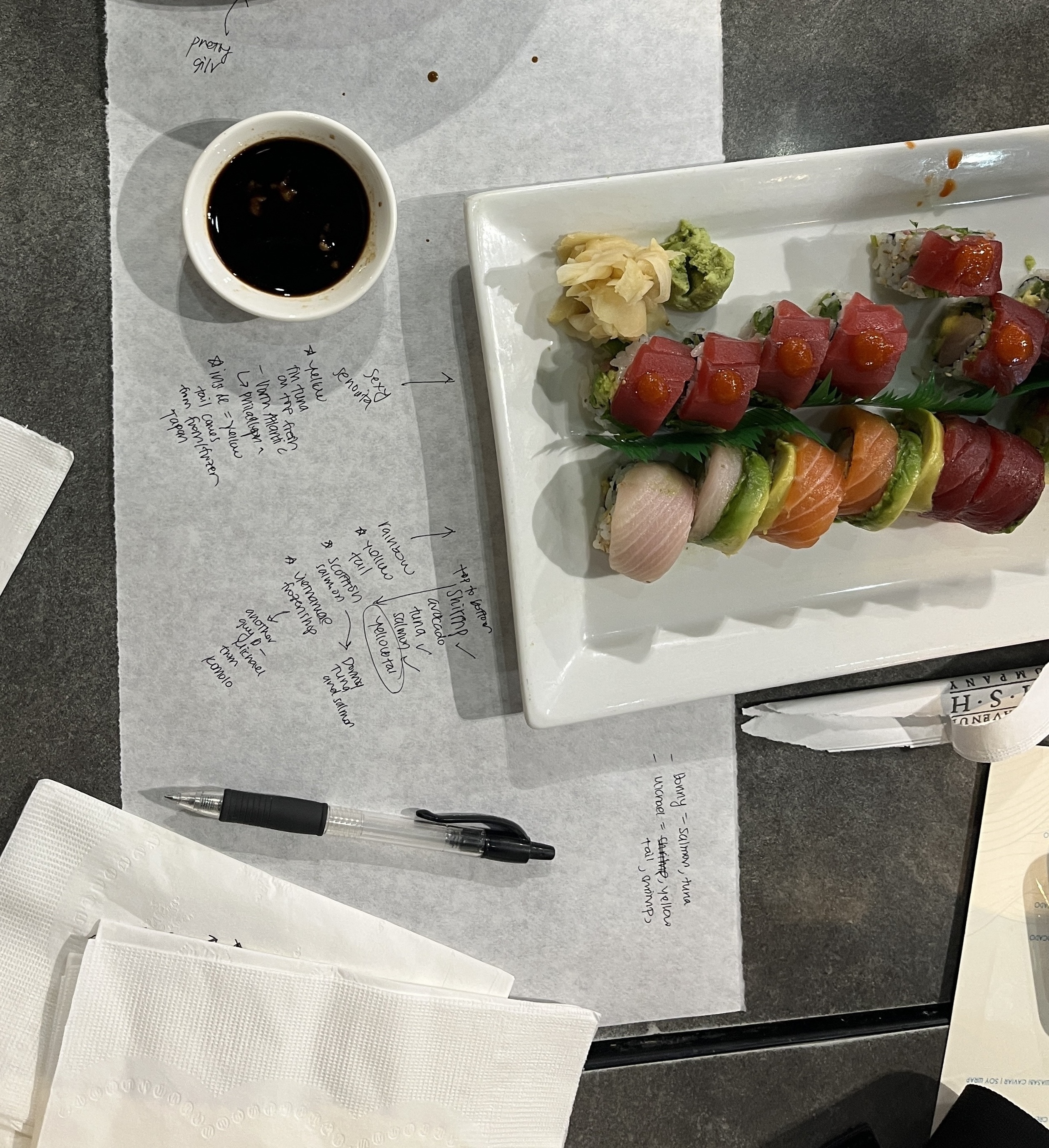
One of his rainbow rolls could contain yellowtail from Japan, shrimp from Vietnam, salmon from Scotland, and yellowfin tuna from the Atlantic.
“The highest quality ingredients make the best sushi,” he said. To Dewey, the best sushi fish is fresh, not frozen. “That makes a big difference. Like, you can really taste it.”
Yet fresh fish, compared to frozen, has a shorter window before it is no longer edible. To transport sushi-grade fresh fish across the world to Pittsburgh, which sits roughly 300 miles from the nearest ocean, is a race against time.
The yellowtail on a plate of sushi at Penn Avenue Fish Company comes from Toyosu Market, a fish market in Tokyo, according to Michael Choi, sales manager for Komolo Inc. The Maryland-based company supplies Dewey with fresh and frozen yellowtail and frozen shrimp.
Yellowtail flies from Tokyo to John F. Kennedy International Airport in New York City, where products are picked up daily, Choi said.
From there, the fish makes its way to Komolo in Jessup, Md., before being trucked to Penn Avenue Fish Company. The whole process, from sea to restaurant, takes just one or two days, Choi said.
The key to keeping fish fresh is how it’s handled, Art Inzinga said. Inzinga is the culinary program coordinator with the Community College of Allegheny County. Ships have icemakers on board to keep the catch cold, if not frozen, he said.
Without the right handling, fish can host parasites — specifically nematodes (roundworms), cestodes (tapeworms), and trematodes (flukes).
The Food and Drug Administration cautions against eating raw seafood. For those who do, the FDA recommends fish that has been previously frozen, which kills any parasites that may be present.
Certain species are more susceptible to parasites, Inzinga said, and sushi chefs typically avoid them. Seafood chefs are, “very, very carefully monitoring their fish every day,” he said. “There is no standard for sushi or sashimi-grade.”
At Penn Avenue Fish Company, that attention to quality carries into the kitchen, where head sushi chef Sky Tao layers shrimp tempura, seaweed, rice, avocado, and spicy tuna and molds it into a roll with plastic wrap and a bamboo mat.
Tao has been making sushi for nearly 30 years, since the late 1990s in New York City. He works quickly, receiving order tags and rolling one sushi dish in just a few minutes.
With the guidance of a good chef, it takes about six months of full-time work to get good at making sushi, Tao said.
Since he started making sushi, the industry has changed. Now, sushi has a bigger market in the United States than in Japan, where sales are declining, according to the 2026 U.S. Sushi Industry Report from the National Fisheries Institute Sushi Council.
That makes business steady for Samuels & Son Seafood Co., a Philadelphia-based supplier where Dewey sources his Scottish salmon and yellowfin tuna.
Scottish salmon is mostly from Scotland, but also from Norway, Iceland, and the Faroe Islands, according to Donny Christiano, front-end manager of the wholesale department. A recent shipment of yellowfin tuna came from Costa Rica and Trinidad.
To get that fish to Pittsburgh, Samuels sends refrigerated trucks to airports including New York, New Jersey, and Philadelphia to pick it up. The fish then makes its way to a warehouse in Philadelphia, where trucks leave in the middle of the night for Pittsburgh, arriving between 4 and 6 a.m.
From there, the fish is sorted in Pittsburgh and delivered to Penn Avenue Fish Company by 7 to 8 a.m.
When eating a plate of sushi, Dewey mixes a bit of wasabi into his soy sauce, which he then gently pours over the rolls.
He recommends eating a whole piece in one bite.
“Sushi should be delicate enough to where you put it in your mouth, and the whole thing should fall apart,” he said. “I call it tasting it with your face.”
“You kind of feel it with your whole brain.”
Hannah Frances Johansson is a reporter for the Pittsburgh Media Partnership newsroom. She holds a master's degree from the UC Berkeley Graduate School of Journalism. Reach her at hannah.johansson@pointpark.edu.
The PMP Newsroom is a regional news service that focuses on government and enterprise reporting in southwestern Pennsylvania. Find out more information on foundation and corporate funders here.
Header image: Henry Dewey, owner of Penn Avenue Fish Company, displays a fresh, whole red snapper on April 14, 2026. Robert Fornataro/PMP



.png)


.png)

.png)

.png)